

New to the Field
Auburn senior finds early success in agricultural journalism
October 01, 2026


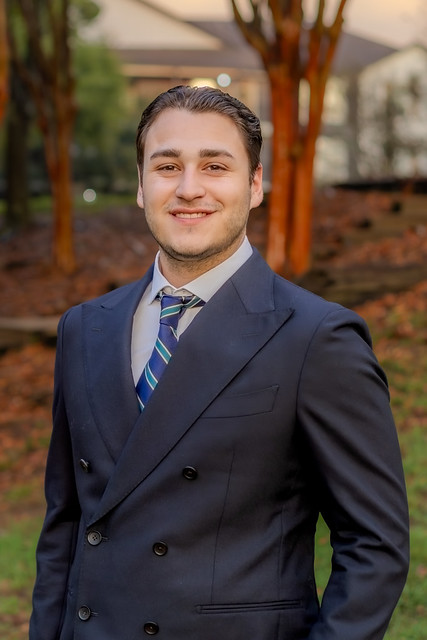
Long before Auburn senior Nick Allen started writing about agriculture, he was surrounded by it.
Growing up in Pennsylvania, farms were part of the landscape. His grandfather spent 30 years as an entomology professor, his uncle was an environmental engineer and Allen was the kid who would rather be outside anyway.
So, when it came time to pick a major, environmental science made sense.
Then he got into chemistry class and realized he wanted to be part of agriculture in a different way.
“I didn’t really want to spend any more time in a lab,” Allen said. “I was much more eager to get out and start making professional connections.”
Agricultural communications gave him that, plus room to pursue another new passion: photography.
“I never really had a designated plan, but I liked the fact that I had so many career options,” Allen said.
Those options ranged from public relations and multimedia to lobbying and, yes, photography. The more he explored, the more he found.
“Every time I looked into it, I found more things that I could do and more things that interested me,” Allen said.
Then he found journalism. That was it.
Allen didn’t consider himself a writer. Not even close. After taking a class with Joan Harrell, a former full-time journalist and current lecturer in Auburn’s School of Communication and Journalism, that began to change.
Harrell watched it happen.
“He really sits back, he listens and he accepts critique,” she said.
In her magazine and feature writing class, Harrell encouraged students to think beyond the grade for class and pitch their stories to media platforms for publication.
“You can pitch your story,” she said. “You could possibly get published as a student.”
Allen gave it a shot.
When his story got published, things got real.
Seeing his work reach an audience changed how Allen thought about where writing could take him.
“After the article got a lot of attention, I realized how cool this was,” he said.
The story started with burning tractors, flying potatoes and one question.
Allen was watching BBC coverage of farmer protests in Paris when he found himself wondering, “Why is no one talking about this?”
So, he started digging.
That question eventually became “Where’s the Smoke?,” a feature published by the high-end agricultural outlet Offrange, which offered Allen his first taste of professional editing.
“I sent [the editor] my first copy and he tore it to shreds,” Allen said. “300 comments later, I thought I was going to have to scrap the whole thing.”
He didn’t. Instead, he kept writing.
The byline in Offrange was a big opportunity. Soon, he’d have another, one that would take his reporting far beyond the classroom.
Allen became one of the first students selected for Auburn’s Rural Journalism Internship Program, created by Harrell and Justin Blankenship, associate director of journalism, with support from Tiger Giving Day.
The program grew from a problem Harrell was seeing across the country: shrinking local newsrooms and growing news deserts, communities with little or no access to local news coverage.
But as news deserts grow, Harrell said, so do opportunities for young journalists willing to step in.
“How do we exist without people being brave and willing to sit down and hold a conversation?” she said. “We need journalists.”
She and Blankenship wondered what it could look like to send Auburn students directly into communities that needed local reporting.
They decided that, for Allen, that community would be Selma, Alabama.
Working with Black Belt News Network publishers Cindy and Brad Fisher, Allen traded the classroom for reporting in a place with stories he couldn’t understand from research alone.
“I’ve done probably 30 interviews,” Allen said of his first story on the challenges Black Belt youth face after school lets out. “It never stops. I still don’t have the quotes I need.”
And as the interviews piled up, he realized the story belonged not just to the data but to the people behind it.
“I took myself out of it and made sure that the writing is about the people,” Allen said.
Allen took his notebook to Selma. He also took his camera, as another way to document the people and places he encountered.
Whether he’s behind the camera or asking questions, Allen has learned the value of showing up, listening and letting people tell their own stories.
In other words, Harrell said, he’s putting in the work.
“This is not about 15 minutes of fame,” Harrell said. “This is about telling the truth, uplifting the voice of the voiceless and verifying complex issues.”
Allen doesn’t know exactly where the major he traded environmental science for will take him next.
Harrell isn’t worried about it.
Whatever it is, she’s sure it’ll make a great story.

